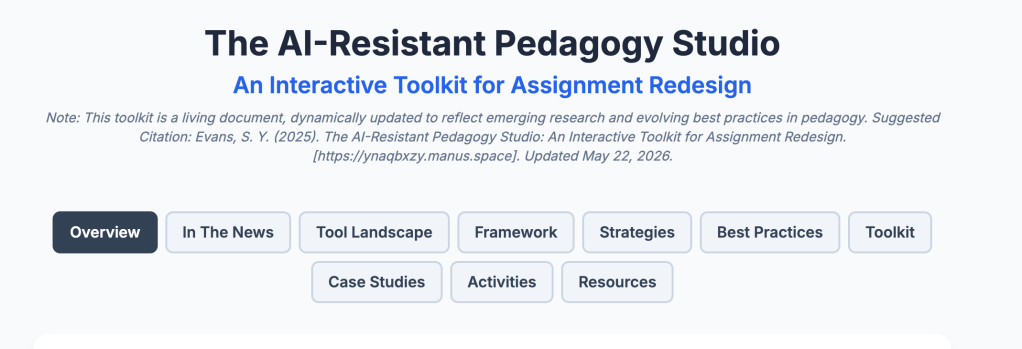
In this episode, I speak with Dr. Stacy Ybarra Evans. Check out The AI -Resistant Pedagogy Studio at https://ynaqbxzy.manus.space/
WELCOME AND GUEST INTRODUCTION
Caleb Curfman: All right, welcome everybody to another episode of Assess Without the Stress. I am your host, Caleb Curfman, and today I am excited, for a few reasons. One, I get to speak to somebody I haven’t spoken to yet. Second, we get to talk about a really cool tool that I have started using this week. It was new to me, but it’s been around for a little bit of time now. But please welcome to the podcast Dr. Stacey Ibarra-Evans.
Stacey Ibarra-Evans: Yes. My name is Dr. Stacey Ibarra-Evans, and I am an educational leader, researcher, and AI literacy strategist whose work sits at the intersection of pedagogy, equity, and the rapidly shifting landscape of agentic AI. So, right now, I am blessed to be the director of the Center for Teaching Excellence at Our Lady of the Lake University in San Antonio, which is a Hispanic-serving institution, actually the first one in the nation. There, I get to learn and design with amazing faculty, world-class faculty, here in the university.
FACULTY BURNOUT, AI ANXIETY, AND HUMAN JUDGMENT
Caleb Curfman: Fantastic! And with that opportunity, I’m sure you get to see many different disciplines as you work with instructional design. And I imagine that, no matter the discipline, one of the biggest things right now, you mentioned it in your introduction, AI and what do we do with it? And I want to just start by saying, we’re recording this when most semesters have just ended, maybe others are ramping up right now with a new semester for summer. And one thing that I notice in my work with faculty development, as well as my teaching, is that the amount of information can get very overwhelming coming at us from all different angles. And so, what have you noticed in this kind of changing world of AI, how has this added to the concerns faculty have? And, you had a recent piece talking about some burnout. Just wondering if you talk a little bit about some of those things that we are all dealing with in higher education.
Stacey Ibarra-Evans: First, I want to say that I’m a fan of keeping the human in the loop, which means, the human always needs to be there to evaluate what AI is currently producing, but what I’ve been seeing on the faculty side is that there is a split among faculty that want to use it, and some faculty that are scared to use it. Mainly because of the safety, privacy, and bias concerns, and most recently, more about the environmental concerns. And so what I try to do with the tool that I have that we’ll go over later is I talk to them about how those opportunities for using AI can be safer in those areas. But the strongest outcomes, I believe, are when humans are in the loop, in the judgment of AI, and not just the execution. And what I’m seeing is that faculty are pushing now more blue books, or hey, they’re going to be doing these assignments, and you’re going to have to do it in front of me, drafts, I want to see drafts, I want to see all these different things, to reduce that friction. right? So, it’s all of a sudden, I need to see accountability, and I feel that faculty members, that’s exhausting, right? As faculty members, it’s like double work, and so I just presented at NISOD about less than 2 days ago, and the whole room, I asked them on a scale of 1 to 5, 1 being, no, and then 5 being yes, how many of y’all had to redesign your assignments from scratch? And everybody put mostly 4 and 5s. So it’s a really big thing right now, and it’s a really big argument for the tool that I’ve created as well.
Caleb Curfman: Yeah, and I’m glad you bring that up, that concern about, how do we approach it? And there are really, there are really two camps. I might say there’s a third. There’s the never touch it, always use it, and then there’s those that when it might make sense, they want to look at it. And I would agree with you that early on, and even more recently, those concerns about privacy and authorship even, some of those ethical concerns, and also the environmental ones, have really been bubbling up in a way that stopped the conversation before it even really got going. We were we got this tool, and I like to say, nobody asked for this tool. It’s something that happened, right? And I think as we go through and we’re experiencing Not only trying to make really good courses and assignments that are truly evaluating those outcomes of our classes, we also need to remember that our students are are humans, which sounds really funny to say, but it is it is one of the things that I’ve tried to lean into lately, is the human side, but also, as faculty, we are humans too, and teaching is one part of us, and I think it’s becoming very overwhelming for some. When it takes so much extra time. I’m glad you mentioned NYSOD. I had the privilege of going and being awarded the award two years ago, and a wonderful conference.
Stacey Ibarra-Evans: Congratulations.
Caleb Curfman: Yeah, thank you. Wonderful conference, and it’s it’s where I first heard about some of these types of strategies, and that’s maybe another thing this time of year, I hope. Faculty have the opportunity to go to a conference that is about teaching and learning, not only discipline-specific, right? Because So much of it, we’re all dealing with the same thing, and in my In my experience working in a two-year community and technical college. I’m having the same concerns that others are in welding and auto body and nursing, and I’m a historian, you know? And so, in some ways, I am an eternal optimist, but it does bring us together in some ways, and I think without teasing it anymore, I would I would love to get into a little bit about a toolkit that you have created that I think is going to and it already has started to, but I think it’s really going to change how how we can approach this and not be so hesitant, not have that cognitive load on us as instructors trying to make one change. And so, to start it out, would you be willing to say a little bit about, because I’m a historian, what was the process? How did you get into this. What what was the beginning of this project for you?
THE AI RESISTANCE PEDAGOGY STUDIO
Stacey Ibarra-Evans: Yes, sir. Well, the first thing is, I want to go back to what you were saying real quick about NISOD. Since I presented, two days ago, the faculty members in the room, when I said, hey, that was my session, you guys are free to continue talking. We had about 25 minutes left in the session, but it was mostly, a workshop. But when I said everybody can leave, nobody left. Everybody wanted to keep on talking to each other. Like you said, the dialogue for this kind of material is really, really important, but that’s kind of the premise of why I created this, because faculty members needed something to lean on. I had faculty members asking me, how can I police my students, instead of how can I help redesign my assignments to be able to have them learn, metacognition. So what I decided to do was I took a course called AI, Caltech Tools for Everywhere. If you know Caltech, they’re a very expensive university in California, and so when I saw that this program was completely free, the first thing I did was I jumped in, right? So they went over multiple large language models, they went over MATIS, they went over the Gamma tool, they went over ChatGPT, and this was about a year and a half ago. But when they went over Manus, I was really, awestruck. Manus is way better than ChatGPT, in my opinion. It’s an agentic AI tool. It doesn’t come, too cheap. It’s a little bit of a costly measure, but I didn’t know that Meta bought them out about maybe about 5 months ago, because they’re that cool, right? So I used Meta to do a bunch of vibe prompting to create a website. And I had no, like. Thoughts about going live with it. I just started to see how useful it was to me, and I thought, you know what, I wanna go ahead and put this out there for people. And honestly, I put it out there for people, and I didn’t really market it until I started seeing universities, cite it on their webpages, and I thought, whoa, how did they find this? it was supposed to be, a personal tool, and they found it. I thought, okay, well, I’m gonna keep on going with it. So I presented, at NISOD, coordinating board. I’ve created I’ve presented, maybe, in the past 5 months, at least 30 to 40 conferences on this one tool. And faculty have been using it like crazy, and I think the best part about it is that they’re giving me feedback. They’re saying, hey, is there a way to upload my assignments? Is there a way for me to be able to do this or that? And so it’s giving me a lot of food for thought. But the main reason about this tool is to help you create a redesign strategy. Not everybody knows what that is. So, when you go to the tool, the very first thing you go to is you’re going to see a page with about a series of about 9 buttons. So, an overview, and that overview describes the current landscape of assignment design, and why we want to start looking at that. And the key implications of the pedagogical shift. And then we go into In the News. And In the News, those are some foundational articles from the last 3 to 4 years that talk about when AI first begun to come on the landscape of pedagogy, to kind of help those understand why I created the tool. And then it goes into the actual evolving tool landscape, so ChatGPT, Gemini, Claude, and how those have influenced, maybe students using them in different ways, and how they use them in examples and practice. And then finally, we get to the framework, and that is the cognitive presence, social presence, and teaching presence, which all come out to be the community of inquiry, and that’s called CoI. And that is created a framework to effectively design AI-resistant learning. And I felt that this model and framework really provided the meaningful learning context to be able to have people understand why I created this tool, and that it fosters skills that AI cannot replicate. And then from those specific areas, social presence, cognitive presence, and teaching presence, I was able to identify AI-resistant applications, including assignments, feedback prompts, peer reviews, brainstorming, things like that, so that faculty members don’t have to work harder, but they work smarter.
Caleb Curfman: Yeah, absolutely, and, right there, I have found the first, again, the whole tool, I have really enjoyed, but That, in the news section, has been so helpful because, kind of like I was saying at the beginning. We’ve been just inundated with information about AI and its usage, and when you are using so many different, you’ve got the Atlantic, the New York Times, using using credible sources to talk about and kind of say how people have been working through it can be so helpful, because I mean, let’s just say it, I go onto social media, and there are things being written by AI, about AI, that maybe isn’t necessarily true. So it’s great that you are linking to these, and something that I’m thinking of doing is using some of those resources you compiled in the news as part of one of my introductory assignments, where students are actually looking at some of these resources, to, to get the conversation going. That’s one thing that I have found is it doesn’t do any good to not talk about AI. If I’m going to a classroom that first couple of days, we have the AI conversation, more than just, here’s what my policy is, and here’s why it is, but digging into it a little bit. And so that is wonderful, but what I really like as well. Is that when you get into the framework, the community of inquiry. I’m interested if you’d talk a little bit more about those three types of presence, just for maybe listeners that aren’t as familiar with the community of inquiry.
COMMUNITY OF INQUIRY, AUTHENTIC ENGAGEMENT, AND ORAL HISTORY
Stacey Ibarra-Evans: Yes, for the Community of Inquiry, it really talks about how people are able to have an interaction of these three core tenets that were created by the Community of Inquiry Framework leaders here. It’s a robust, human-centric structure that allows them to be able to foster skills that AI cannot replicate. And it’s only one half of it, so going to that social presence, the cognitive presence and the teaching presence, to be able to facilitate the direction of the learning of the student, so that way they can actually have meaningful and worthwhile learning outcomes, not just saying, hey, do this, and then when they get that prompt, they take it to ChatGPT, and boom, they put it in, and it’s already there. No, instead of that, hey, here’s an assignment where it’s multi-stages. And, maybe a bibliography, or a proposal, where the research process is visible without asking, show me your progress. So that way it doesn’t make them feel like they’re dumb, it doesn’t make them feel like they are trying to do too much work, because that will come out in your personal evaluations as a faculty member. This student is making this faculty member is making work too hard. Or I didn’t find value in this course, or maybe the faculty member didn’t give me exactly what I need to do to facilitate my learning. So, by doing this, the student is not seeing it, but at the end of the semester, when they think about it, they’re oh, I really did learn, this is what I’ve learned, you know? The framework then takes it into the community strategies, which are going to be cultivating collaborative inquiry. And then authentic engagement and metacognition. The faculty member’s able to pick one of those three strategies to be able to leverage processes and skills unique to each one of those things to see its concept and rationale on the toolkit itself. And so they’re able to see, for example, why it’s AI-resistant on the toolkit. The type of practice assignments, like jigsaw, peer review, or team-based learning. And then at the very bottom, there’s actually tools to do that, like Miro or FigJam, so that way, maybe you don’t know how to do this. Well, we can’t tell you how to do all of it, but here’s a little bit of a little insight of that. And so, because some faculty members, maybe they don’t have time for PD, but they want it real quick, and here’s, a little living framework for that. And then it carries on to, best practices, like UDL, and how this aligns with that, transparency and co-design, and how this aligns with that. Because there are some naysayers that’ll tell me, and I still get them on this day, if you’ll see my LinkedIn, I’ll get people, boom! And I don’t respond to them right away sometimes, because, it’s like I have to think about it, because sometimes they are right, and, I have to change the way I’m thinking. But, I have to put why I decided to create this way, and what supports that. And then my favorite part is the toolkit we were talking about earlier, where you actually select a current assignment. You can’t upload it, but you can select a research paper, or an exam, or a literature review, or a presentation, a PowerPoint presentation. And then from there, you gotta state, what are you trying to get the student to do with this assignment? Because you have the assignment for a reason. You have these learning outcomes for a reason. And so, maybe you want them to remember something, understand something, apply, analyze, evaluate, or create, and then the student selects that, they select a redesign strategy from collaborative inquiry, authentic engagement, or metacognition from CoI, and then they click on generate redesign, and then boom, they have a really quick strategy that allows them to have a new plan. That they can pretty much use. And the reason I created this toolkit, aside from all those different steps, is because the students no longer have one correct answer findable through ChatGPT. They now have to provide local context and lived experience. No longer is it a quick summary or a paraphrasing, it requires more than that. And then now, the student voice is not interchangeable; it’s no longer optional, so that’s why I created this tool.
Caleb Curfman: Yeah, and one assignment that I have I have done, for a few years now, that And this is what’s kind of cool about the tool. Didn’t realize I was doing something until I see the tool. I think, oh, there is a reason why this worked really well. It’s in the research. The assignment I had students do in my Modern American History class is interview somebody that was 50 years old or older, and do an oral history. And I went in here, and I thought, okay, what could I do for my, for another class, or, what if I, I still was doing a research paper? How would I change that? And so I went through the steps, and And I’m gonna obviously link to the toolkit in the episode, because this is a audio, so it’s a little hard to talk through it, but I went through and I went, okay, step one, I’m gonna select the standard paper. I wanted students to create something new using the highest level of Bloom’s taxonomy. And then I wanted it to be authentic engagement, so choosing the redesign strategy, and when I generate it. It tells me to do exactly that assignment that had worked so well for me, an oral history interview with a community member. There we go. So that is why. And so, I think this is such a valuable tool Even if you are maybe doing things that are more authentic, it gives you some research behind it as well, because As I am the only full-time history and political science instructor, I don’t have as much time as I would like to do some of that scholarship of teaching and learning research. Well, now this tool can work in that way as well. And so I really appreciate how it’s not just the quick chat bot. I won’t name them, but there are a few out there that say, hey, we can help you with your assignments, and you just put something in and it shoots something out at you. To me, that’s not as helpful as this, because this is saying, well, here’s why this works, and it’s also a springboard To get to get the gears going in your head, right? Oh, now, what if I did this? What if I did that? And so What has been you’ve talked a little bit about the response so far, but what are some of the things that you have seen immediately after launching this tool. Where faculty are, feeling about it. Sounds like they’re liking it, I would say it’s it’s wonderful, but how has it changed, maybe, what you do in your job, by having this resource available?
ASSIGNMENT-LEVEL AI POLICIES AND PROFESSIONAL DEVELOPMENT USES
Stacey Ibarra-Evans: So, yes sir, it’s given me a lot of time to think about AI policy, continued policing, right? We don’t want to continue policing people. So, at my university, the time that I’ve had, I’ve been able to create the, stop, red light, green stoplight kind of AI policy. Have you seen those before?
Caleb Curfman: Yep, yep.
Stacey Ibarra-Evans: So the red, green, and yellow. So, at our university, I’ve added, it was pretty much badges that faculty members can put within their syllabus, because even though the studio works fantastic, there are still some naysayers that say, well, they’re still going to use AI. Well, they will only use AI if you let them. So the secondary level of this, toolkit is to set policy for assignments, not for the course, but per assignment. And that’s where, hey, AI prohibited. AI can only be used in ways that will not undermine the learning goal. For example, if you’re going to use it for in-class writing, as a thought partner, it’s allowed in this course. And then, for example, the yellow, limited AI use with citation per instructor, maybe drafting or brainstorming, but not for more than that as a purpose. And then the last one is the green one, which is clarify-with-instructor use. That will allow them to use it for maybe allowable scope, and encourages dialogue over assumptions. So, I tell faculty members. Because I’ve been seeing that. I heard that at NISOD, too, overheard it, faculty members, well, they’ll still find a way to cheat. Well, not if you provide those kinds of AI assignment policies. And I also have faculty members that are able to create AI-resistant rubrics that kind of reward the visible thinking, that are able to reward those drafts, those reflections, and those process notes, so that faculty and students can work together to see what excellence looks like. Excellence looks like in each class.
Caleb Curfman: Yeah, absolutely, and And you mentioned that tool that helps you with some of those AI policies. When I go into I guess kind of going down the line, I wanted to make sure we talk about the case studies, but first, I want to talk about the activities piece of your toolkit, because I’m seeing this as a wonderful thing as a professional development person who is working with our faculty, you have created a workshop for me here. That is fantastic, right? this idea of. Tasks of, think of a strategy, take a standard assignment, and think about ways you could redesign it, right? And then you have this tool for AI policy crafting. And you can choose whether it’s permissive, limited, or prohibited. Again, using the stoplight approach. With some really good examples that come through with it. And so, I just want to say, for those of you out there that are instructional designers, work in faculty development, this tool not only is going to help you with helping individual faculty, but I could see this as a a short, kind of, workshop, quick, quick brain, brain session is what we call it here, where we just talk through it, right? And And giving those steps. But I would like to go back for a second, because, I jumped over the case studies, which is another kind of piece of your tool. So what is that all about?
CASE STUDIES AND ADOPTION ACROSS CAMPUSES
Stacey Ibarra-Evans: So, when I was making this tool, I started to think to myself, who’s already doing things like this? But maybe they’re not doing it the way I’m doing it, but what currently exists so that people it’s believable, right? People also talk about renewable assignments, because that sounds like a different term, maybe it sounds a little bit more friendly, but renewable and redesigned assignments are pretty much the same thing. And I found these universities were actually using them, so Stanford actually has it, where they’re doing it in a writing kind of scenario in the humanities. And then Carleton is using it as their psychology process portfolios, and because they’re doing it this way, their students are having maybe, a deeper understanding of their creative processes. And they also have an improved artistic self-awareness when they’re doing these kind of projects. But now, I actually have living case studies at other colleges actually using my tool. So I’ve been able to see, at Clemson University, they’re using it for their admissions applications. I see that University of Houston downtown are using it for their Lunch and Learns. South Dakota State University is currently using it for their professional development resources, right under Harvard University, so I’m getting a lot of, people pushing this tool, and I feel that them just finding it is a blessing, number one, but I’m also kind of getting the wheel spinning of what I want to do next. Do I want to do, maybe, workshops for faculty, myself, you know? Yes, so I’ve already begun to start thinking about what I want to do next with this AI Resistance Pedagogy Studio, since I’ve already presented maybe, 45, 50 sessions in the past fall and spring. I’m thinking either doing a workshop series, a digital badge series, maybe, getting called out to universities to do, actually, hands-on workshops. Whatever people need, so if people want to reach out to me, they can reach out to me at my work email. But I also have the, tool upgrading and still being updated on the website itself, so if they have any questions, they can also tell me, hey, add this, or change this way, so I’m here for that as well.
BUILDING AND UPDATING TOOLS IN MANUS
Caleb Curfman: Yeah, and so with that piece of it, so it looks like you used Manus to create this. How does that work? When you say it’s continuously updating, is it part of, adding more prompts for you to how does maybe walk through that process, in case somebody wants to, use something like that a little bit more.
Stacey Ibarra-Evans: So, when you create a tool in Manus, you go back to, it’s like if you went back in Gemini, where you can go back to the prompt and find whatever you created, like a slide deck, whatever, it’s like that. When you go back to that actual prompt. You can go ahead and click on Edit on the prompt itself, and then it’ll throw you into the website, and then once you’re in the website, at the bottom right-hand side, it usually says Made with Manus, but when you’re in edit mode, it says Tweak with Manus, or, change it, you know? So I click on tweak, and then it allows me to go and make changes to the title. Not too many changes to the information, because that, it becomes a little harder. Because once it’s actually created, it’s hard to change the website. Also, I don’t change it in the middle of people using it. That’s another thing. So I just add, in the beginning, overview page information. I’ll add information in the news, but I won’t change anything about the toolkit or activities itself, because people are still using that, you know?
Caleb Curfman: Yeah, absolutely, absolutely. Well, that’s fantastic, and, you’re just giving me so many things to think about now, not only in the assignment design, but now I want to dig into Manus a little bit, because I’m not as familiar with Manus. And, do you see potential for Manus in In teaching, in some ways, as well?
Stacey Ibarra-Evans: Yeah, I think it’s a better, tool to create vibe-prompting assignments or websites, because I’ve created another one already called the Human Agent Standard. One of my colleagues messaged me in the middle of the night and said, hey, I saw this article in Inside Higher Ed that says we need to get with Agentic Skills fast. And that if we don’t tell students this information, they’re gonna be kind of outdated when they graduate. And I started to think about how could I do that? And so what I did was I went to the Occupational Outlook Handbook, I went to, the different websites, Labor Outlook, Demand, and I put that information into the prompts for the website, and I was able to create, hey, this is the job I want. What agendic skills do I need? And so, that’s what I’m working on now. It’s not fully deployed yet, I’m still working on it as a pilot, but I feel that educators, especially those in K-12 and dual credit, can kind of share this with them when they’re trying to do their endorsements, hey, when you are done with high school, and you want to go on to college. You can look at this website before you even decide about a major if you want to do all this kind of work, because it’s going to be a lot more work. They have to learn a lot more about agentic skills. And if you ask employers now. They are kind of still, awestruck by AI, but they’ll let we need people that know how to use it, and they’re not afraid to say it anymore. Maybe about a year ago, they were afraid to say how they use it, but now they’re saying no. Just like faculty are redesigning their assignments, employers are redesigning their work plans, they’re redesigning their job descriptions, they’re redesigning their process of how people are hired and fired and all that stuff, and so we need to get with the program as higher ed insiders. To tell our students, hey, this is what we know. And it might not scare them as much as we think it might scare them, because at the end of the day, they want more money. And we want that for them as well, you know?
AGENTIC SKILLS AND THE FUTURE OF EDUCATION
Caleb Curfman: Absolutely, and, to that point. It is everywhere now. My text messages now have summaries that come from AI, and so I think it’s part of it is becoming more familiar with it, and it even though I wouldn’t say it’s wrong to be somewhat fearful, I think we have to be very cautious, but also, it’s not going away. I think there was a moment there where people thought, oh, here’s the next big thing, and it’ll be gone soon. It’s really only increased in its usage, in all pieces of our lives, and globally as well, and so I think that’s a really interesting approach, and I’m looking forward to hearing about that tool. Again, as somebody who works at a college where we have, many students who are still trying to figure out what they want to do, which could be said for all colleges. What a great opportunity to see what those changes might be. And so, as we’re kind of beginning to wrap up, a question I like to ask people who are kind of deep into this AI world, and I know no one’s gonna make fun of you if you’re completely wrong, but my question is, where do you think AI and all of this in education, where do you think it’s gonna go next?
Stacey Ibarra-Evans: I honestly think that we are going to be expanding the role of educator instead of shrinking it. A lot of people are saying, oh, we’re going to be shrinking this role as educator. No, that’s not the truth. We’re going to be going from, content deliverers to learning experience architects. We’re gonna be going from AI detectors to AI transparency educators. We’re gonna be going from, course managers to, community connectors. It’s gonna be bringing us back to maybe the times when we have more time to hang out with our friends, to hang out with our colleagues, and be able to talk about the good practices we have, because we’ll have time to spend time on AI to help us redesign our assignments and have critical reflection pieces, and be able to develop ideas at the drop of a hat. Versus, oh, it’s gonna take me a long time, you know? I don’t have time for that. But I love the way it’s going right now. I know people are scared, and I think if you’re scared, take as many AI literacy classes as you can. LinkedIn Learning has a wealth of them. Udemy, U-D-E-M-Y, I don’t know if it’s spelled right, they have a bunch of them. I know that my library allows people to use their library card to get free access to LinkedIn Learning, which allows you to have different certifications. But what I learned 2 years ago is vastly different from what I’ve learned last month. And you need to know something that changes from day to day, because if not, people will ask you something, and you think, oh, okay, well, I didn’t know that. And you have to go research it, and sometimes you think, oh, okay, I should have known that. But at the same time, you give yourself grace, then move on and learn.
Caleb Curfman: Yeah, absolutely. That is such great advice, as well as what a positive outlook. I would agree, I think there is there’s a lot of positivity coming here, and, it’s in the toolkit. It could really be its own episode. I’ve talked about it before, but the way that UDL comes into play here is fantastic. With all this, and I see so many opportunities for accessibility and UDL with AI. And I know, I’m gonna link to a few of the things that you have done recently that kind of connect to that as well. But I just want to thank you so much for the time, and for creating this thing. I mean, the fact that we have something now as a great step, not only for those of us who have been in the AI world for a bit, but also for those that are brand new and looking at a place to start. You hit that sweet spot of it has enough for the person that knows about it, and it is not so overwhelming for the person who is just stepping into this world. So, thank you so much for joining me.
Stacey Ibarra-Evans: Yes, thank you, I love it.
Caleb Curfman: All right, thank you everybody for listening to this episode. As always, thank you as you go to the show notes, look at the resources, try out the toolkit, make sure to subscribe, all that fun stuff, and have a great week, and as always, I am so glad you are here.

